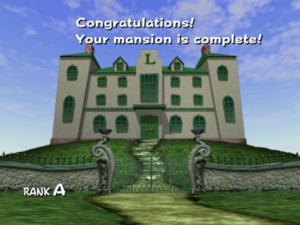
Seeing as Halloween is fast approaching and since Nintendo is about to release a remake of the game, I figured now would be as good a time as any to pull out this old gem, and give it a good analysis. Note, this analysis pertains only to the original GCN version of the game. Many of my gripes about this version may well have been cleaned up for the New 3DS remake. I’m not sure, as it is not yet released, and I may or may not be getting it, as I don’t particularly like buying remakes of games I already own, unless the remake offers some substantial difference from the original.
I can still remember fondly reading about Nintendo’s latest console (then code named “Dolphin”) in the pages of my beloved Nintendo Power magazines. When I first heard about this radical new game featuring Nintendo’s favorite punching bag, I couldn’t wait to play it. And when the day finally came (Christmas of 2001, I believe it was, for me) I was in awe. I loved every second of Luigi’s Mansion (LM) back in the day. It was unlike anything I’d ever played before. However, it’s been seventeen years (holy crap…) since that first playthrough, and games have come a long, long way. However, if you dust off the cobwebs, you’ll find that, at it’s core, LM still has some great elements, and can still be a fun, albeit short and sometimes poorly aged, time.
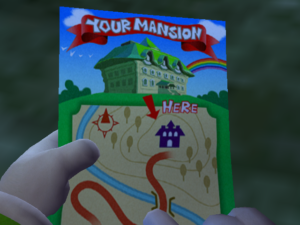
The whole premise of Luigi’s Mansion is fairly simple (as all Mario games are). In a short cutscene, we see that Luigi has won a fabulous new mansion. However, when he arrives Luigi finds that this mansion is anything but. The place is infested with ghosts of all sort, along with a strange little man.

The strange little man is none other than Professor E. Gadd (get it?), a ghost researcher who informs Luigi that this mansion just popped up overnight a few days prior, and he was investigating the place. Of course, Gadd expresses that he’s too old for this sort of stuff, and entrusts Luigi with his invention, the ghost-sucking vacuum cleaner, the Poltergust 3000, to explore the mansion in his stead, and rid it of it’s otherworldly occupants. Of course, to “sweeten” the pot and really make sure the cowardly Luigi goes through with the quest, Gadd informs him that another “feller” dressed like him, except red, went to the mansion a few days ago, and hasn’t been seen since. So, with the knowledge that Mario is in peril, Luigi steels his nerves, and enters the haunted mansion with nothing more than a flashlight, and a modified vacuum cleaner.
Gameplay in LM really is as simple as those two pieces of equipment (with some exceptions that I’ll detail later). It is in its simplicity that LM shines, though. Too often is a game overstuffed with mechanics and whatnot. Keeping it simple means that the game can succeed on its core premise alone, without the need for overcomplication. That core mechanic, of course, is catching ghosts.
In LM, Luigi catches ghosts in a simple two step process. Once a ghost appears in a room, Luigi must hit it with a beam of light from his flashlight, stunning it, then begin to suck it up with his trusty Poltergust 3000. Like I said, simple. But in the case of the original LM, almost a little too simple. Because the mechanics are so very basic at their core, not much thought seemed to be put into how to handle them.
Mainly, I’m referring to the flashlight. Luigi has his flashlight out by default, any time he’s not using the Poltergust. This means the light is constantly shining, unless you press and hold a button down, to keep it off. This is a bit irritating, because the ghosts are, naturally, sensitive to light. When his by light, the ghosts are stunned, making them catchable, however, if a player has accidentally hit a ghost with the light without meaning to, then that can screw up everything. See, ghosts, being ghosts, aren’t always visible. They appear, they attack, they disappear. They also disappear after being stunned, when Luigi fails to start sucking them up with the vacuum cleaner. So, because the light is always on, its easy to screw up a stun you never meant to happen. This is compounded by the aiming. The flashlight is aimed wherever Luigi is facing. If Luigi spins around, the light spins with him. He can aim the light up or down using the C-stick, but the controls are frustratingly inverted, and cannot be changed (I will never understand some gamers’ obsession with inverted controls… your minds are broken…). Aiming can be a similar, but lesser, issue with the Poltergust. Aiming is inverted with that thing as well, and the inability to change that horrid control scheme is very frustrating. However, the Poltergust requires a lot less finesse, so it was never as big an issue for me.
When these two mechanics worked in tandem, though, they worked well. Stunning enemies then sucking them up with a vacuum could be a lot of fun. Once Luigi started up the vacuum portion of the fight, it turned into a sort of “fishing” video game. The ghost would wail and fight, trying to flee the powerful suction of the Poltergust, while the player would need to keep the pressure on, using both the joystick and C-stick to “pull back” on the ghost, essentially reeling it in. Each ghost has a health meter displayed via number, when the number reached zero, the player would finally “land their catch” and capture the ghost. Like I said, simple, but fun.
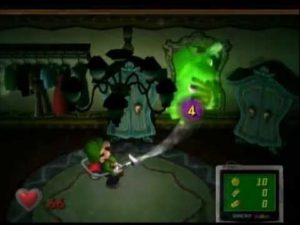
Seeing as the whole goal of the game is to clear the mansion of ghosts, this process is done quite literally. Luigi must go from room to room. Almost all rooms have ghosts of some type or another, and once the ghosts were cleared out, then the lights would turn back on, and that room would remain free of ghosts for (almost) the rest of the game. Of course, clearing room after room of basic ghosts would get a little dull and repetitive pretty dang quick, so, luckily, LM also features “portrait ghosts.”
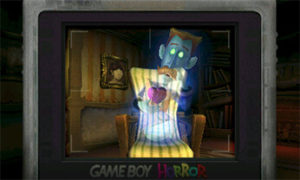
Portrait ghosts are bigger ghosts with unique designs and personality. And each one must be caught in its own unique way. Most portrait ghosts don’t pay much attention to Luigi at first. His flashlight will have little effect on them, outright. The player must discover clues on how to reveal their weaknesses, before they can begin the process of stunning and sucking. For some, this might be an easy solution, but others might have the player stumped. Enter the Game Boy Horror. Good ol’ E. Gadd took an old Game Boy Color, and redesigned it for Luigi to use on his adventures. In addition to serving as the game’s UI and Map, Luigi can use the camera function to enter a first-person investigatory mode. Using this mode, Luigi can scan a ghost for clues as to how to make them vulnerable. It’s a fun little addition, and nice for those that need a helping hand. And the fact that it’s completely optional is the best part of all.
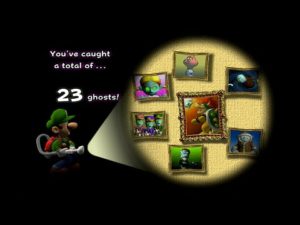
Of course, portrait ghosts are a bigger deal than the standard variety of ghost, and they’ll put up a much bigger fight. Once a player has begun sucking up a portrait ghost, they will fight strongly against them. If the player is careful in where and how they are pulling the joysticks, they will easily be dragged along the floor, causing damage to Luigi, and potentially loosing their grip on the ghost. Portrait ghosts will also drop the occasional poison mushroom, causing Luigi to not only take damage, but to shrink as well, making him unable to use the Poltergust, until he regrows to normal size. For the steadfast player that is able to keep the Poltergust going on a ghost, draining their health from 100 to 0, they will be rewarded a ton of money (money is the game’s way of scoring a player, the more money they have accumulated by the end of the game, the better an ending they will get; it’s also worth noting that any time Luigi takes damage, he’ll drop a small amount of money). Players will also get a nicer portrait frame for that particular ghost. See, once caught, Gadd turns the ghosts into harmless portraits, and their frames will be either bronze, silver, or gold, depending on how well a player did in that particular fight.
However, none of this happens until Luigi clears an area. This is done by defeating the “boss ghost.” As the name obviously implies, boss ghosts are the biggest deals in the game. There are four of them, and defeating each one will give Luigi a key that will allow him to access an area of the mansion he otherwise could not get to. One other perk of defeating a boss ghost is that the hallways of the area previously explored will finally light up (unlike rooms, hallways cannot be cleared of ghosts through the normal means, making traversal in the mansion quite a pain until the area’s boss ghost is dealt with).
There’s one more mechanic, and one more type of ghost that I need to address, though. I’ll start with the mechanic.
About halfway, maybe a third of the way, through the game, Luigi will find an elemental medal. These items allow Luigi to suck up elemental ghosts, small sprite-like beings that appear out of elements like fire, ice, and water. Once obtained, Luigi has the option to spout out whatever element he’s caught, from his Poltergust. This can be used in a variety of ways, such as lighting candles, watering plants, putting out fires, et cetera. However, these elemental powers are also used to fight ghosts that only become weak after being hit with a specific element. This clunky additional mechanic was completely unnecessary, in my opinion, and did absolutely nothing for the game. The controls to fire the elements often did not work with enough precision to ever feel good. And that cannot be overstated enough when talking about the third boss ghost, Boolossus.
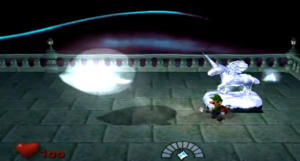
Boolossus is a horribly designed boss fight. Not just in the context of this game, but in general. Comprised of multiple boos, Luigi must lure the giant boo to the pointy end of a unicorn statue, to pierce it, causing it to explode into multiple normal sized boos. Luigi must then use his ice elemental powers to freeze the small boos, then suck them up. With the aforementioned poor aiming controls mixed with the imprecise, clunky elemental controls, I’ll let you guess just how much fun this fight is… it’s awful. But it does bring me to the final ghost type that I wanted to talk about.
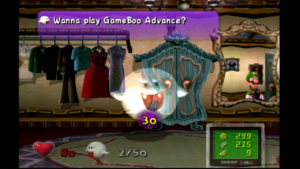
Very early in the game, Luigi accidentally unleashes a horde of boos, that classic ghost monster that’s been a part of the Mario Bros. series since SMB3. Problem is, boos only hide in rooms that are lit. So, in order to find all 50, the player must revisit all the rooms that have already been cleared. Once there, they must make use of the Game Boy Horror once again, this time using the flashing radar-like light on the device to find hidden, “round” objects. These objects might be boos, or they could be balls with the face of a boo painted on them, or they could be a bomb about to explode. You never know! After thorough investigation of a room, a boo will finally pop out, and it’s up to Luigi to catch it. Problem is, boos don’t get “caught” in the Poltergust’s suction like normal ghosts. They can pretty much just move freely. And that includes moving through walls. If a player isn’t quick enough, the boo will escape, flying through one of the room’s walls. The player can give chase, and maybe catch it in another room or hallway, but sometimes the boo will escape into a room that the player does not have access to yet, and at that point, they’re kinda screwed until they get further into the game. It’s all very frustrating. Worse of all is the prize. Just a lot of money. Yeah, it’s the game’s way of scoring the player, but it just doesn’t feel like a substantial enough reward, considering how big a pain those boos can be.
But as I said before, all complaints aside, when you can look past the game’s flaws and poor aging, at its core, LM is still a fun game, or at the very least, has the core of a great game concept. There have been a lot better iterations on this concept in the 3DS sequel, Luigi’s Mansion: Dark Moon, and I’m greatly looking forward to the newest iteration for the Nintendo Switch. But I’ll always have a soft spot in my heart for the original game in the series, cobwebs and all.